In July, domestic tin ore imports continued to rise, with imports from the Democratic Republic of the Congo and Australia reaching historical highs [SMM Analysis].

Published: Aug 20, 2024 18:28
Source: SMM
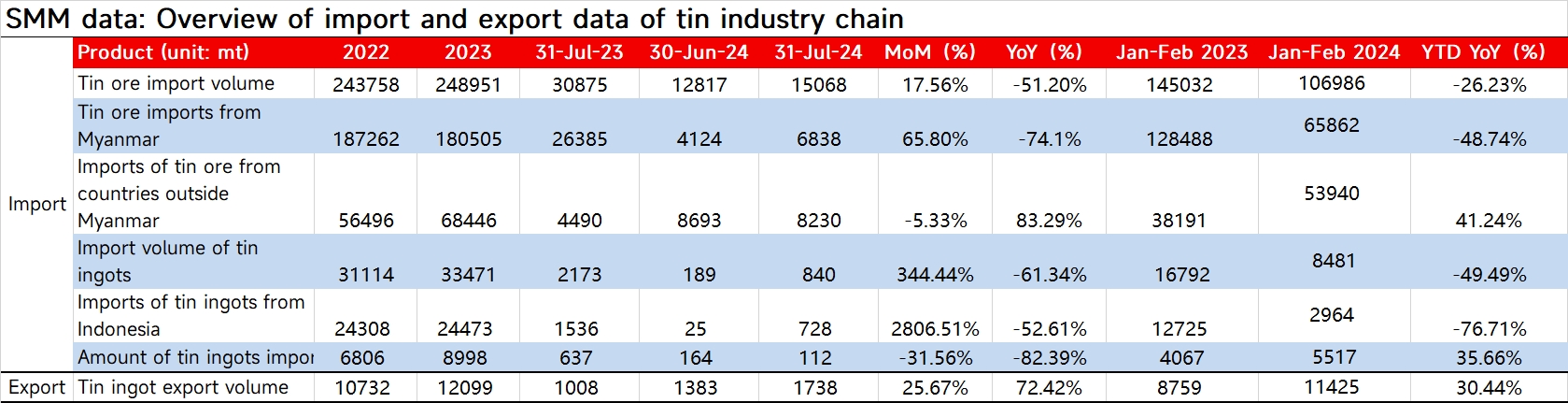
In July, domestic tin ore imports were 15,000 mt (metal content approximately 6,429 mt), up 17.56% MoM, down 51.20% YoY, and increased by 1,270 mt compared to June. The cumulative imports from January to July were 106,000 mt, down 26.23% YoY. In July, domestic tin ingot imports were 840 mt, up 344.44% MoM, down 61.34% YoY. The cumulative imports from January to July were 8,481 mt, down 49.49% YoY.

In July, domestic tin ore imports were 15,000 mt (metal content approximately 6,429 mt), up 17.56% MoM, down 51.20% YoY, and increased by 1,270 mt compared to June. The cumulative imports from January to July were 106,000 mt, down 26.23% YoY. In July, domestic tin ingot imports were 840 mt, up 344.44% MoM, down 61.34% YoY. The cumulative imports from January to July were 8,481 mt, down 49.49% YoY.

In July, domestic tin ore imports showed an upward trend, mainly due to increased imports from Myanmar and the Democratic Republic of Congo (DRC), while imports from other countries remained stable. Specifically, tin ore imports from Myanmar in July were 6,800 mt (metal content approximately 2,025 mt), showing an increase compared to June 2024. Although the authorities in Wa State, Myanmar, have not provided a clear timeline for the resumption of tin ore production, market analysis and forecasts suggest that Myanmar's tin ore imports will remain relatively low in Q3. Meanwhile, tin ore imports from the DRC and Australia are also on the rise. Since the suspension of production in Myanmar, the share of tin ore imports from Africa and other regions in the total domestic imports has continued to increase, and this trend is expected to persist, stabilizing at a high level for some time. Historical data analysis shows that tin ore imports from the DRC and Australia have reached historical highs, partially alleviating the market supply gap caused by Myanmar's mining ban.

On the other hand, with the intermittent opening of the tin ingot import profit window, domestic tin ingot imports have started to show an upward trend. According to the latest data, tin ingot imports in July increased to 840 mt, with imports from Indonesia reaching 727 mt. Considering the recent brief reopening of the tin ingot import profit window and factors such as shipping schedules, some imported tin ingots are expected to arrive in the domestic market in August. However, due to the limited and unstable opening time of the import profit window, tin ingot imports are unlikely to recover to the levels of the same period last year.

Additionally, domestic tin ingot exports in July also showed an upward trend, with specific data at 1,738 mt, up 25.67% MoM and 72.42% YoY. The cumulative exports from January to July 2024 reached 11,425 mt, up 30.44% YoY. However, considering the recent closure of the export window, tin ingot exports are expected to decline in the future.

Data Source Statement: Except for publicly available information, all other data are processed by SMM based on publicly available information, market communication, and relying on SMM‘s internal database model. They are for reference only and do not constitute decision-making recommendations.

For any inquiries or to learn more information, please contact: lemonzhao@smm.cn
For more information on how to access our research reports, please contact:service.en@smm.cn
Related News
CAICT Releases Report on Intelligent Computing Power Services, Forecasts 130B Yuan Market by 2025
Apr 30, 2026 18:14
CAICT Releases Report on Intelligent Computing Power Services, Forecasts 130B Yuan Market by 2025
Read More
CAICT Releases Report on Intelligent Computing Power Services, Forecasts 130B Yuan Market by 2025
In April, the Cloud Computing and Digitalization Research Institute of the China Academy of Information and Communications Technology (CAICT) officially released the *Research Report on Intelligent Computing Power Services*, based on continuous research and extensive surveys. The report, grounded in the trends of large-scale AI application and computing power servitization, systematically reviewed the development background, conceptual connotations, system architecture, key technologies, typical scenarios, market size, industry chain landscape, and future trends of intelligent computing power services. For the first time, it constructed a three-layer system architecture for intelligent computing power services, proposed three core service forms—intelligent computing power resource services, intelligent computing power interconnection services, and intelligent computing power application services—and estimated that China's intelligent computing power services market size exceeded 130 billion yuan in 2025.
Apr 30, 2026 18:14
Chongqing Unveils Action Plan to Boost AI, Digital Growth in Chengdu-Chongqing Circle by 2030
Apr 30, 2026 18:12
Chongqing Unveils Action Plan to Boost AI, Digital Growth in Chengdu-Chongqing Circle by 2030
Read More
Chongqing Unveils Action Plan to Boost AI, Digital Growth in Chengdu-Chongqing Circle by 2030
The Chongqing Municipal People's Government issued a notice on the "Chongqing Action Plan for Promoting the Development and Capacity Enhancement of the Chengdu-Chongqing Twin-City Economic Circle (2026–2030)." The notice stated that efforts should be made to promote the mutual empowerment of artificial intelligence and "Digital Chengdu-Chongqing," explore the coordinated linkage of key elements such as computing power, data, application scenarios, and policy ecosystems between Sichuan and Chongqing, and support AI technology R&D, application, and industrialisation in the Chengdu-Chongqing region. By 2030, the intelligent computing power of the Chengdu-Chongqing computing hub period will reach 100,000 PFLOPS, the city will have built more than 10 AI industry application pilot testing bases, and will have cultivated 20 vertical large models and 5 major projects with national influence, with daily average token invocations leading in western China.
Apr 30, 2026 18:12
Data: SHFE, DCE market movement (Apr 30)
Apr 30, 2026 15:54
Data: SHFE, DCE market movement (Apr 30)
Read More
Data: SHFE, DCE market movement (Apr 30)
The following table shows the ferrous and nonferrous metals movement on the SHFE and DCE on 30 Apr , 2026
Apr 30, 2026 15:54